Zur Steuerung meiner Rolladen habe ich mir eine Schaltung einfallen lassen die über das Netzwerk möglich ist und somit in den FHEM integriert werden kann.
Damit können die Rollos von 4 Fenstern unabhängig von einander gesteuert werden.
Aktive Komponenten:
- Arduino Nano
- Replaiskarte 8 Port – 5V
- LanModul ENC28J60
- Spannungswandler auf 3.3V
- Schaltnetzteil auf 5V
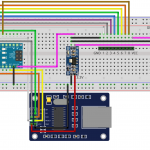
Hier der aufbau der Schaltung:
Das Sketch für den Arduino:
/*
ENC28J60 Anschluss:
SCK -> 13
SO -> 12
SI -> 11
CS -> 8
Vcc -> 3.3 V
GND -> GND
*/

#include <EtherCard.h>
#define REQUEST_RATE 5000
#include <string.h>

static byte mymac[] = { 0x75,0x68,0x69,0x2E,0x31,0x33 };
char* on  = "ON";
char* off = "OFF";

const int led = 15;
int pinAnz=8;
int pin[8]={2,3,4,5,6,7,9,10};
int offTimer=0;
int offTimerStart=0;

String switchNr;
String state;

int stateRollo1=9;
int stateRollo2=9;
int stateRollo3=9;
int stateRollo4=9;

BufferFiller bfill;

byte Ethernet::buffer[700];

void setup () {
  Serial.begin(9600);
  Serial.println("Getting IP via DHCP");

  for (int i=0; i < pinAnz; i++){
    pinMode(pin[i], OUTPUT);        //alle Pins aus dem Array als Ausgabe deklarieren
    relaisOff();    //alle Pins aus dem Array einschalten
    Serial.println(pin[i]);
    }

  if (ether.begin(sizeof Ethernet::buffer, mymac) == 0)
    Serial.println( "Failed to access Ethernet controller");

  if (!ether.dhcpSetup())
    Serial.println("DHCP failed");

  ether.printIp("My IP: ", ether.myip);
  // ether.printIp("Netmask: ", ether.mymask);
  ether.printIp("GW IP: ", ether.gwip);
  ether.printIp("DNS IP: ", ether.dnsip);

  Serial.println();

/*  pinMode(RELAY_PIN, OUTPUT);
  digitalWrite(RELAY_PIN, LOW);
  relayStatus = false;
  relayLabel = off;
  linkLabel = on;*/
}

void loop () {
    if (offTimerStart==1){
    offTimer=offTimer-1;
    Serial.println(offTimer);
    if(offTimer==0){
      relaisOff();
      offTimerStart=0;
    }
    }

    word len = ether.packetReceive();
    word pos = ether.packetLoop(len);

  if(pos) {
    String puffer = (char *)Ethernet::buffer + pos;

    //http://192.168.11.160/?switch1;1  Hoch
    //http://192.168.11.160/?switch1;0  runter
    //http://192.168.11.160/?switch1;3  Stop
     Serial.println(puffer);
    if (puffer.startsWith("GET /?switch")){
    puffer.remove(15);
    switchNr=puffer.substring(12,13);
    state=puffer.substring(14,15);
    Serial.println(switchNr);
    Serial.println(state);

    //zeit setzen zum ausschalten der Strom Relais, Schleife, wenn 0 aus
    offTimerStart=1;
    offTimer=6000;  //Zeit auf des Rollo mit der laengsten hoch/runterfahrzeit einstellen

    // Rollo bewegen: hoch=1; runter=0
    switch (switchNr.toInt()) {
      case 1:         //Rollo 1
          if (state!="3"){
            digitalWrite(pin[0], LOW);      //Strom ein
            digitalWrite(pin[1], !state.toInt());    // Hoch/runter
              //Serial.println(pin[2] & !state);
          }
          else{
            digitalWrite(pin[0], HIGH);
          }
          stateRollo1 = state.toInt();
        break;
      case 2:         //Rollo 2
         if (state!="3"){
            digitalWrite(pin[2], LOW);      //Strom ein
            digitalWrite(pin[3], !state.toInt());    // Hoch/runter
              //Serial.println(pin[2] & !state);
          }
          else{
            digitalWrite(pin[2], HIGH);
          }
          stateRollo2 = state.toInt();
        break;
      case 3:         //Rollo 3
           if (state!="3"){
            digitalWrite(pin[4], LOW);      //Strom ein
            digitalWrite(pin[5], !state.toInt());    // Hoch/runter
              //Serial.println(pin[2] & !state);
          }
          else{
            digitalWrite(pin[4], HIGH);
          }
          stateRollo3 = state.toInt();
        break;
      case 4:         //Rollo 4
           if (state!="3"){
            digitalWrite(pin[6], LOW);      //Strom ein
            digitalWrite(pin[7], !state.toInt());    // Hoch/runter
              //Serial.println(pin[2] & !state);
          }
          else{
            digitalWrite(pin[6], HIGH);
          }
          stateRollo4 = state.toInt();
        break;
      default:
      break;
    }
  }
      bfill = ether.tcpOffset();
      bfill.emit_p(PSTR("HTTP/1.0 200 OK\r\n"
      "Content-Type: text/html\r\nPragma: no-cache\r\n\r\n"
      "<html><head><meta name='viewport' content='width=200px'/></head><body>"
      //"
<div style='position:absolute;width:200px;height:200px;top:50%;left:50%;margin:-100px 0 0 -100px'>"
      "
<div style='text-align:center'>"
      "Rollo1:$D <a href='/?switch1;1'>hoch</a> <a href='/?switch1;0'>runter</a> <a href='/?switch1;3'>Stop</a>
"
      "Rollo2:$D <a href='/?switch2;1'>hoch</a> <a href='/?switch2;0'>runter</a> <a href='/?switch2;3'>Stop</a>
"
      "Rollo3:$D <a href='/?switch3;1'>hoch</a> <a href='/?switch3;0'>runter</a> <a href='/?switch3;3'>Stop</a>
"
      "Rollo4:$D <a href='/?switch4;1'>hoch</a> <a href='/?switch4;0'>runter</a> <a href='/?switch4;3'>Stop</a>
"
      "</div>
</div>

</body></html>"
       ), stateRollo1,stateRollo2,stateRollo3,stateRollo4);
      ether.httpServerReply(bfill.position());
  }
}

void relaisOff() {
  for (int i=0; i < pinAnz; i++){
  digitalWrite(pin[i], HIGH);     //alle Pins aus dem Array einschalten
  }
}
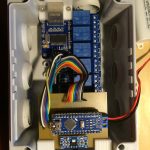
Der fertige Kasten:
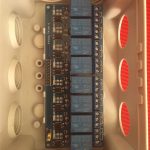
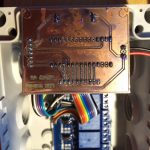
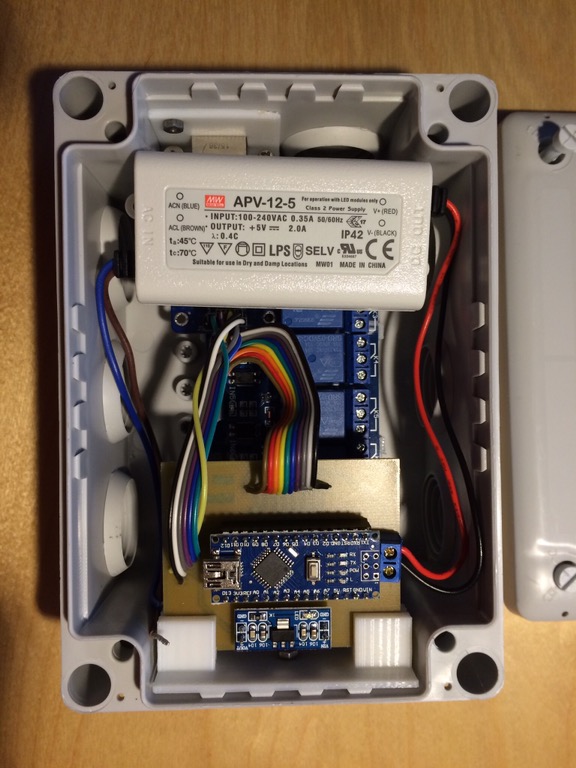
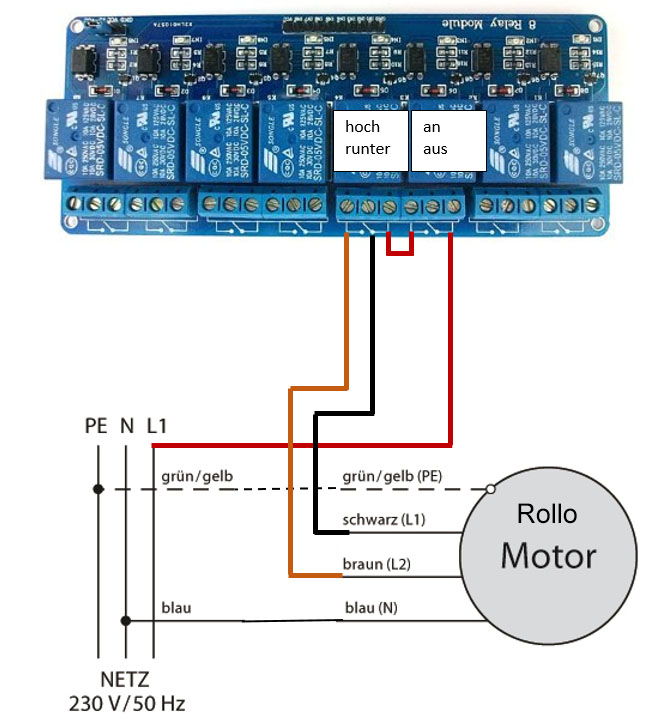
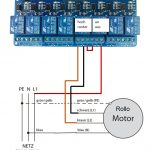
Anschlussschema an den Rollomotor:
FHEM Integration:
define webRollos HTTPMOD none 0
attr webRollos userattr get01Name get01URL get1Name reading01Name reading01Regex readingFormat readingMap set01IMap set01Name set01ParseResponse:0,1 set01URL set02IMap set02Name set02URL setIMap
attr webRollos alias Rollos
attr webRollos devStateIcon 0:fts_shutter_100
attr webRollos enableControlSet 0
attr webRollos get01Name rollost1
attr webRollos get01URL http://192.168.1.13/?status
attr webRollos reading01Name RolloStat1
attr webRollos reading01Regex Rollo1[^0-9]+([0-9\.]+)
attr webRollos readingMap 0:oben, 1:unten, 3:Stop, 9:Unbekannt
attr webRollos room Rollos
attr webRollos set01IMap 0:on, 1:off, 3:stop
attr webRollos set01Name dy_Rollos1
attr webRollos set01URL http://192.168.1.13/?switch1;;$val
attr webRollos set02Name Rollow2
attr webRollos set02URL http://192.168.1.13/?switch2;;$val
attr webRollos stateFormat RolloStat1

Schreibe einen Kommentar